


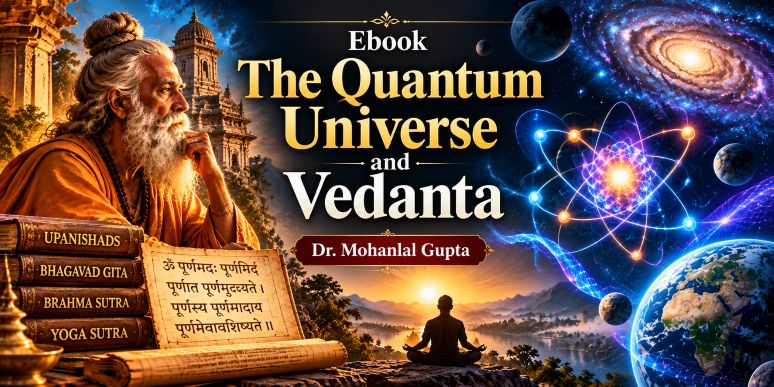
Ebook The Quantum Universe and Vedanta: Exploring the Connection Between Quantum Physics and Ancient Indian Wisdom
Introduction: Ebook The Quantum Universe and Vedanta
The Ebook The Quantum Universe and Vedanta by Dr. Mohanlal Gupta explores an intriguing intellectual question: can modern quantum physics and the ancient Indian philosophical tradition of Vedanta help us examine some of the deepest mysteries of existence? The book brings together discussions of the universe, matter, energy, consciousness, and the search for ultimate reality.
For centuries, the relationship between science and religion has been complicated by historical conflicts, philosophical disagreements, and differences in their methods of understanding the world. In Europe, the persecution of individuals accused of heresy contributed to an atmosphere of hostility between certain religious institutions and intellectual inquiry. In subsequent centuries, some scientific thinkers became deeply sceptical of religious explanations of nature. This scepticism sometimes extended beyond European religious traditions and influenced their interpretations of Indian religion, philosophy, and spirituality.
Indian philosophical traditions, however, developed their own methods of inquiry into existence, consciousness, and the nature of reality. The Upanishads and Vedanta do not approach every question in the same manner as experimental science, but they offer a rich intellectual framework for examining the relationship between the individual, the universe, and ultimate reality.
The Ebook The Quantum Universe and Vedanta considers these traditions alongside the conceptual developments of modern physics. Its purpose is to encourage readers to explore the questions that arise when scientific investigation and philosophical reflection are placed in conversation.
1. The Search for Ultimate Truth in Vedanta Philosophy
One of the most profound questions in both philosophy and science concerns the ultimate nature of reality. What is the universe made of? Is the visible world the complete expression of existence, or does it conceal deeper structures that cannot be understood through ordinary perception alone?
The Isha Upanishad presents a description of ultimate reality that challenges conventional distinctions between presence and absence, movement and stillness, and interior and exterior existence. It declares that the Supreme Reality is near and far, moving and unmoving, within everything and beyond everything.
A related vision appears in the Shrimad Bhagavad Gita, where the divine is described as pervading the universe while also transcending it. These expressions invite readers to consider whether the reality we observe represents only one aspect of existence.
Dr. Sarvepalli Radhakrishnan, in his interpretation of the Bhagavad Gita, emphasised that eternal Truth cannot be confined to one isolated formulation. The Truth from which other truths emerge is too comprehensive to be exhausted by a single description.
This philosophical approach does not mean that every explanation is equally valid. Rather, it suggests that profound questions may require different forms of inquiry and that human understanding has limitations.
The Ebook The Quantum Universe and Vedanta examines this search for ultimate reality by placing the philosophical language of the Upanishads alongside questions raised by contemporary physics.
2. Quantum Physics and the Changing Picture of the Universe
The development of quantum physics during the early twentieth century transformed scientific understanding of matter and energy. Classical physics had successfully explained many aspects of the observable world, including the motion of objects and the behaviour of large physical systems. However, investigations of atoms, electrons, and radiation revealed phenomena that could not be fully explained using classical models.
Quantum theory introduced concepts such as quantisation, probability, wave functions, and the measurement of physical properties. It demonstrated that the behaviour of matter at microscopic scales differs significantly from the behaviour of familiar objects in everyday life.
These developments challenged the assumption that nature could always be described as a collection of solid objects possessing definite properties independently of the conditions under which they were observed.
Quantum physics did not establish that ancient Indian philosophy was scientifically correct in every respect. Nevertheless, its unfamiliar concepts encouraged some scientists and philosophers to reconsider older assumptions about matter, observation, and the limits of human knowledge.
This is one of the central themes explored in the Ebook The Quantum Universe and Vedanta. The book considers whether the conceptual challenges presented by quantum theory can encourage a fresh examination of questions that Indian philosophers have discussed for centuries.
3. Oppenheimer, the Atomic Explosion, and the Bhagavad Gita
One of the most widely discussed encounters between modern physics and Indian literature occurred during the development of the atomic bomb in the Second World War.
On 16 July 1945, the first nuclear test, known as the Trinity Test, took place in New Mexico, United States. The immense flash produced by the explosion represented a turning point in human history. J. Robert Oppenheimer, the American theoretical physicist who directed the Los Alamos laboratory, later recalled a verse from the Bhagavad Gita when reflecting on the experience.
The verse, found in Chapter 11 of the Gita, describes the extraordinary radiance of the divine form revealed to Arjuna:
Divi surya-sahasrasya bhaved yugapad utthita,
Yadi bhah sadrishi sa syad bhasas tasya mahatmanah.
The verse conveys the idea that if the radiance of a thousand suns were to appear in the sky simultaneously, it might resemble the splendour of that great divine form.
Oppenheimer’s recollection illustrates how an ancient Indian text could provide language for reflecting on an unprecedented modern event. His reference to the Gita also demonstrates the continuing cultural and philosophical significance of Indian literature.
However, the historical significance of this episode should not be confused with scientific proof that the Gita predicted nuclear physics. Rather, it illustrates how literature, philosophy, and science can intersect in the human effort to interpret experiences that challenge ordinary understanding.
The Ebook The Quantum Universe and Vedanta uses this encounter as an entry point for considering the relationship between scientific discovery and the philosophical imagination.
4. Matter and Energy: A Meeting Point for Scientific and Philosophical Inquiry
Modern physics has established that matter and energy are closely related. Einstein’s famous equation, E = mc², expresses the equivalence of mass and energy. Nuclear reactions demonstrate that small changes in mass can correspond to enormous amounts of released energy.
Quantum theory further explains the behaviour of particles and fields at microscopic scales. In contemporary physics, elementary particles are understood through quantum fields and their interactions rather than simply as tiny, solid pieces of matter.
Vedanta approaches the question of reality through a different conceptual framework. In Advaita Vedanta, Brahman is understood as the ultimate, non-dual reality underlying the multiplicity of the experienced world. The visible universe and the ultimate ground of existence are examined through philosophical reasoning, scriptural interpretation, and contemplative inquiry.
These approaches should not be treated as identical. Physics develops mathematical models and tests them against observations and experiments. Vedanta investigates questions about existence, selfhood, and ultimate reality through philosophical and contemplative methods.
Nevertheless, both can inspire reflection on whether ordinary appearances provide a complete account of existence.
The Ebook The Quantum Universe and Vedanta explores this possible meeting point, inviting readers to consider the difference between the physical description of matter and the philosophical question of what ultimately grounds reality.
5. Consciousness: A Central Question in the Study of Reality
Consciousness remains one of the most challenging subjects in philosophy and scientific research. How does subjective experience arise? Why do physical processes in the brain accompany awareness, thought, emotion, and perception? Can consciousness be fully explained through physical processes, or are additional conceptual approaches required?
These questions are relevant to neuroscience, cognitive science, philosophy of mind, and some areas of theoretical research. However, quantum physics has not established that consciousness creates the universe or that all matter originates from consciousness. Such propositions remain philosophical interpretations rather than accepted conclusions of quantum theory.
Indian philosophical traditions have investigated consciousness through a different route. In Advaita Vedanta, consciousness is central to the inquiry into the nature of the self and Brahman. The tradition challenges the assumption that an individual’s ordinary identification with the body and mind provides a complete account of the self.
The expression Eko Brahma Dvitiyo Nasti is commonly used to convey the non-dual idea that ultimate reality is one and without a second. It reflects a philosophical position in which the apparent multiplicity of existence is understood in relation to a fundamental unity.
The Ebook The Quantum Universe and Vedanta considers this concept in the context of modern questions about consciousness. Its central invitation is to investigate the issue thoughtfully without assuming that philosophical similarity automatically establishes scientific equivalence.
6. Advaita Vedanta, Yoga, and the Discipline of the Mind
While quantum physics investigates physical systems through mathematical theory and experimental evidence, Indian contemplative traditions place considerable emphasis on disciplined observation of the mind.
Patanjali’s Yoga Sutras defines yoga through the well-known expression:
Yogash chitta-vritti-nirodhah.
This is commonly translated as “Yoga is the cessation of the fluctuations of the mind.”
The expression describes a central objective of classical yoga: bringing mental activity under disciplined awareness so that the nature of experience can be examined more clearly. Meditation and other contemplative practices have been developed within Indian traditions to cultivate concentration, self-understanding, and equanimity.
Vedantic inquiry also examines the distinction between the changing contents of experience and the awareness through which they are known. These are philosophical and contemplative investigations, not substitutes for laboratory experiments.
The Ebook The Quantum Universe and Vedanta brings attention to this difference in method. Its discussion suggests that an understanding of reality may involve questions that are not exclusively about external objects but also concern the nature of the observer and the experience of knowing.
This approach can encourage dialogue between scientific study and the humanities, provided that the claims of each field are evaluated according to appropriate standards.
7. Samadhi and the Mysteries of Yogic Practice
Indian spiritual literature contains accounts of advanced yogic practices, including samadhi, a state associated with profound meditative absorption. Traditional accounts sometimes describe extraordinary control over bodily processes or experiences that appear to transcend ordinary limitations.
Stories of yogis remaining underground for extended periods have also circulated in India. Such accounts raise questions about physiology, respiration, metabolism, and the limits of human endurance.
However, claims that a person can remain alive for days without breathing require reliable, independently verified evidence. There is no established scientific basis for the assertion that a yogi can survive indefinitely without oxygen by closing a particular opening in the body or retaining vital air in the brain. Nor has quantum physics provided a confirmed explanation for such claims.
Scientific investigations of meditation and breathing practices have found that certain techniques can influence measurable physiological processes, including breathing rate, heart rate, and stress responses. These findings do not establish the extraordinary abilities sometimes attributed to yogic adepts.
The Ebook The Quantum Universe and Vedanta raises questions about the relationship between traditional accounts of yogic experience and modern scientific understanding. This subject is best approached through a combination of respect for historical traditions, careful documentation, and a willingness to distinguish reported experiences from independently demonstrated phenomena.
8. Quantum Particles, Waves, and the Nature of Matter
One of the most distinctive features of quantum physics is wave-particle duality. Quantum objects can display wave-like or particle-like behaviour, depending on the physical system and the experimental arrangement.
For example, electrons and photons can produce interference patterns characteristic of waves, while certain measurements reveal localised detection events. Quantum theory describes these results through mathematical frameworks that predict the probabilities of different experimental outcomes.
This does not mean that every quantum object is literally a tiny wave and a tiny particle in the everyday sense. Instead, quantum objects do not fit neatly into the categories developed from ordinary human experience.
The discovery of these behaviours changed the scientific picture of matter. What appears solid and stable at the human scale is, at more fundamental levels, described through complex interactions and quantum properties.
Vedanta, meanwhile, questions the ultimate status of the material world and examines the relationship between appearances and underlying reality. Although the philosophical meaning of these ideas differs from the mathematical description of quantum systems, both subjects can stimulate reflection on the limitations of everyday intuition.
In the Ebook The Quantum Universe and Vedanta, the discussion of quantum particles and waves forms part of a broader exploration of the subtle structures underlying the visible universe.
9. The Possibility of Multiple Universes
Indian literature contains numerous descriptions of vast cosmic orders. Some traditional narratives imagine innumerable worlds or universes, extending far beyond the limits of ordinary human perception. The poetic expression Rom rom prati lage koti koti brahmand evokes the idea of countless universes contained within every pore.
Modern cosmology, too, has inspired scientific discussions about whether our observable universe is the entirety of existence. Some theoretical models in cosmology and fundamental physics permit possibilities commonly described as a multiverse.
However, the multiverse is not an experimentally established fact. Different proposals involve different assumptions, and many remain difficult or impossible to test with present observational methods. Quantum physics itself does not universally require the existence of multiple universes; some interpretations of quantum mechanics invoke them, while others do not.
The similarities between certain traditional cosmic images and modern multiverse proposals are therefore best understood as points for philosophical comparison rather than proof that ancient texts anticipated a specific scientific theory.
The Ebook The Quantum Universe and Vedanta examines this subject as part of the wider question of cosmic origins, the extent of existence, and the limits of human knowledge.
10. Why Study Quantum Physics and Vedanta Together?
Science and philosophy ask questions that sometimes overlap but do not always use the same methods to answer them. Science relies on observation, measurement, mathematical modelling, experimentation, and reproducibility. Philosophy examines concepts, assumptions, arguments, and the meaning of experience. Spiritual traditions may also include disciplined contemplative practices and inherited bodies of interpretation.
A productive conversation between these approaches requires both openness and intellectual caution. Scientific discoveries should not be presented as proof of spiritual doctrines unless the evidence actually supports that conclusion. Equally, philosophical traditions should not be dismissed merely because they approach questions through methods different from those of experimental science.
The Ebook The Quantum Universe and Vedanta seeks to create space for such a conversation. It explores the relationship between matter, energy, consciousness, the universe, and ultimate reality, drawing on modern scientific concepts and the philosophical heritage of India.
For readers interested in Indian philosophy, quantum theory, cosmology, and the history of ideas, this comparison offers an opportunity to examine how different traditions frame some of humanity’s enduring questions.
11. About the Ebook The Quantum Universe and Vedanta by Dr. Mohanlal Gupta
The Ebook The Quantum Universe and Vedanta is an intellectual exploration of quantum physics, the creation of the universe, and the philosophical insights associated with Vedanta. Written by Dr. Mohanlal Gupta, the book considers how modern scientific ideas can be read alongside ancient Indian reflections on consciousness and the nature of existence.
The work also examines traditional accounts of subtle realities and extraordinary experiences within the visible world. These subjects remain challenging because the philosophical contexts of ancient texts are not always easy to reconstruct, while present-day scientific knowledge does not provide established explanations for every traditional claim.
The book therefore invites readers to engage with the subject through study, reflection, and critical examination. It does not remove the distinction between scientific evidence and philosophical interpretation; instead, it encourages readers to explore the questions that emerge when the two are brought into dialogue.
Its wider purpose is to stimulate interest in India’s intellectual traditions and to encourage a more thoughtful discussion of the relationship between ancient wisdom and modern science.
Conclusion: Exploring the Universe Through Science and Vedanta
The relationship between quantum physics and Vedanta is a fascinating subject because both invite us to reconsider familiar assumptions about reality. Quantum theory has transformed scientific understanding of matter, energy, and the behaviour of the microscopic world. Vedanta offers a philosophical investigation into consciousness, the self, and the ultimate ground of existence.
Their methods and conclusions are not identical, and similarities between them should not be mistaken for scientific proof of ancient philosophical claims. Yet the questions they raise can enrich intellectual discussion when examined carefully and without prejudice.
The Ebook The Quantum Universe and Vedanta by Dr. Mohanlal Gupta brings these themes together in an effort to encourage readers to think deeply about the universe and humanity’s place within it.
For students of Indian philosophy, readers interested in quantum physics, and those curious about the relationship between science and spirituality, the book offers a starting point for further study and reflection.
This Ebook-The Quantum Universe and Vedanta is available on kindle
The Hindi edition of this book is also available in paperback and Hindi eBook formats.


